Friday, 8 August 2014


Watching democracy in action and watching paint dry have many things in common.
They both take a long time, they both become tacky after a few hours, then they suddenly dry up – and the job is over.
Oh yes – and despite your best efforts, there are always a couple of unavoidable drips around the place.
Thus it was with Tuesday night’s meeting of Boston Borough Council’s Planning Committee.
It moved from its usual comfort zone in the Worst Street committee rooms to the Haven High Academy,  supposedly to accommodate the vast numbers expected to attend – although by the morning of the meeting, fewer than 75 public tickets had been requested.
Not only that, but the meeting was webcast, and viewers were confronted with the dramatis personae of this video nasty perched in chevron formation on a brightly lit stage like the opening scene of one of those modern dramas that you switch off almost immediately – all of them nominally supervised by vintage Councillor Mary Wright … to use the word chaired would be a misnomer.
So, following a ten-year gestation, the Quadrant planning proposal was delivered after four hours of labour.
Not being a regular attender at occasions such as this it was an interesting event to observe.
Three members of the committee sent apologies and substitutes were put in their place.
Councillor Maureen Dennis was replaced by Councillor Gloria Smith, Colin Brotherton by Stephen Woodliffe and Alison Austin by Helen Staples.
Two members of the committee declared an interest because they were season ticket holders at Boston United.
The lion’s share of the opening of the meeting was taken up with an almost page-by-page account of his report delivered by Boston’s Development Control Manager Paul Edwards.
We wondered about this, as – assuming that the members should have already been word perfect on the contents of this ponderous tome – the proffered  gloss was nowhere near enough for them to grasp the complexities of the plans.
And if they had not read it the same applied.
Mr Edwards seemed as much out of his comfort zone as the rest, and single-handedly provided body language experts with enough activity for a thesis, treating viewers to an almost non-stop procession of distracting activities – running his fingers inside his collar, adjusting his spectacles, wiping his hand across his gleaming pate, and regularly sipping water, which was invariably followed by a thunderous detonation as his glass banged down beside the microphone.
The recommendation to the committee was that it should support the Quadrant development – which at this stage is solely for a football stadium shoehorned in to a site to the east of the A16.
The rest of the plan – for 500 houses, plus a superstore, other shops, an hotel et al –  is called an “enabling development”  which means that the location of buildings, their appearance, scale and landscaping, for example, are all “reserved” for future submission and consideration.
In other words, your guess is as good as ours.
The meeting followed a strict pattern, with lower echelon champions and antagonists from the public allotted the same bite-sized amounts of time – three minutes – to make their case.
We heard of fears regarding the health of people living alongside a 7,000 seater stadium, fears about traffic congestion and accidents, concerns about flooding, and many more besides.
As far as flooding is concerned, there seems to be a problem – and whichever way you cut it some existing properties are likely to be at risk of more significant flooding when the estates are built – as this slide from the presentation makes clear.
But this appeared to be brushed aside as – at the very worst – the  water level would only be four inches higher than it otherwise might be.
Then there were concerns over school places – apparently, the “experts” reckon that 500 new homes will only require 76 more primary school places – and the added strain on local health services.
Proponents from the football club made out that without it, Boston would be a bleak and discouraging place – perhaps they should get out more, then they would see that these fears have already been realised.
After a “comfort break” the meeting heard longer presentations, from the developers and the parish council.
At various points throughout, where objections were made, the wrecking ball was passed back to Mr Edwards for demolition.
Then it was the turn of the Planning Committee members, and we heard variously from Councillors David Witts (Independent Group 2)  Bob MacCauley (Lincolnshire Independent)  Alan Lee  (Independent)  Steven Woodliffe (Conservative)  Ossy Snell (Independent) Yvonne Gunter (Conservative) Michael Brookes (Conservative)    Gloria Smith (Conservative)   Derek Richmond (Conservative)   and Helen Staples (Independent Group 2.)  
We heard some concerns, and also much support, including phrases such as “we have to be a town that aspires” and that “sometimes there are sacrifices that we have to make.”
Then was also the need to tell people “we are open for business and want to move forward,” and that “Boston is going somewhere.”
Generally, where councillors had concerns they soon wound their necks in and only one additional condition concerning the timing of a management plan for the stadium was imposed.
The voting took just 30 seconds – and that included a lot of faffing around.
The proposal was passed by ten votes in favour and two against – the opponents being Councillors Smith and Snell.
After four hours, a jury of our peers had sat through the trial of the Quadrant One proposal – and many people will feel that the verdict was a death sentence for Wyberton.
Our overall feeling was one that can best be summarised by the famous quotation often attributed to Samuel Johnson – that the road to hell is paved with good intentions
We came away from four hours glued to the screen with the impression that whilst some councillors tried their best, they were simply not well enough equipped to understand and appreciate such a complex issue.
What did emerge was that unlike most councils, Boston does not have a local plan – although why this should surprise us, we do not know.
The nearest that it got to one in “recent” years was the Interim Plan (Non-Statutory Development Control Policy) February 2006.
This was intended as a replacement for Adopted Plan 1999, which was the subject of public consultation from March 1993 through to July 1997. It was adopted in April 1999, but withdrawn from the statutory adoption process in February 2006. “Nonetheless,” says Worst Street, “we adopted a revised version of the replacement local plan for development control purposes - this document is known as the Interim Plan (Non-Statutory Development Control Policy). However, little or no weight can be given to the policies of the Interim Plan that were the subject of significant objections to the first draft or re-deposit draft Local Plan stages.”
We hope that this clarifies things for you.
If not, bad luck – as  an internet link to view this plan, whilst mentioned, appears to have been removed.
The report approved by councillors on Tuesday notes: “There is conflict with or certainly a failure to comply with the development plan as a whole. This is since the Local Plan is not up to date or complete across all the necessary topic headings and it is thus not possible to consider this application only against the Plan.”
The knock on effect of all this is that Boston lacks of a five year supply of deliverable housing land across the borough.
Had the council been more attentive to such crucial detail, the development just passed might not have been needed
Finally, we are proud to announce the Boston Eye awards for Tuesday’s marathon.
The Captain Mainwaring - “Right then. Pay attention, men” Award goes to the so-called chairman of the committee, Councillor Mary Wright, who not only declared that there were no proposals on the table at the end of the meeting when there were, but also got the names of the proposers and seconders wrong.
The Dr Who Lost in Space Award goes to Councillor Yvonne Gunter, for the quotation: “We are living in the 18th century and we need to pull our socks up …”
The Here today, gone tomorrow (well at least after the comfort break) Award goes to Boston’s Chief Executive – or his double – who was spotted in the audience in the first half of the meeting, but not in the second …
The Sleep of the Just Award goes to … well, we won’t name her but we are sure that the councillor in question briefly parted conscious company with the meeting, although returned with a start before beginning to snore.
And the Cap and Bells Award goes to Councillor Gloria Smith for seemingly missing the point –  although we have to say, that  as a replacement for Councillor Dennis, Councillor Smith completely lived up to our expectations.
In the Music Category, there is only one candidate, and our award goes the haunting air played during the test transmissions ahead of the webcast, and also during the show itself – we think that the title is something about an iron bedstead being put through a grinder.
And the Missing Person Award goes to western film star Roy Rogers’s horse Trigger (pictured left) – who was mentioned so often by Mr Edwards in particular that we expected him to clatter in and join in the whinnying at any moment.

***

In his most recent Epistle to the Bostonians, our saintly leader has been bragging about how “well represented” Boston borough has been at “major meetings of minds from central and local government” in the past few weeks.
Quite correctly, he says: “I know that some critics view our representation at such events as a waste of time,” and continues “but these are the opportunities we seize to ensure Boston, the borough and its burning issues are placed before the people who matter – and nothing beats face-to-face.
He cites a sit down with Eric Pickles, the communities and local government minister, and Owen Paterson – recently sacked as environment minister.
Certainly these two qualify as “minds” in terms of their position in government – although any promises from Mr Patterson are, of course, no longer worth the paper they are printed on.
But whether these “minds” felt that they had met with intellects comparable to their own is another matter.
Moving on, the leader mentioned the attendance of  “councillors and senior officers” at the Local Government Association's annual knees-up, the All Party Parliamentary Local Government Group and the Coastal Communities Alliance.
All of these are regular meetings of  the “club” that councils belong to – and in the case of the first one listed, the cost of attendance is £500 per head … and that does not include hotel and travelling expenses.
But don’t let the facts get in the way of a good story.
“For the first time three of our recent successful projects were highlighted by the District Councils' Network – Fly Swat, garden waste collections and our swimming partnership at the Geoff Moulder Leisure Complex. These best-practice case studies can be seen at http://districtcouncils.info/ where other councils are invited to see how ‘district councils are changing lives and shaping places.’ It is gratifying to see that some of ours are among the best ideas in the country.”
It sounds good, doesn’t it?
But the fact is that almost all of the 200-plus district councils have published details of schemes – and all that seems to be needed to qualify for a place in the league is to post your boast.
Submissions can be made for each year from 2011, and this is the first time that Boston has made any. It sounds more as if a window of opportunity was noticed and the chance  to blow the council’s own trumpet was irresistible than to promote anything of novel or great significance.
Operation Fly Swat, for instance, relies on forced prison labour (didn't we once call them chain gangs?) and using volunteers to do the job that we pay the council to carry out.
Bragging about the garden waste scheme, the council boasts proudly of “a carrot-and-stick approach” to encourage residents to stop putting green waste in with their wheelie bins waste.  Surely, that’s really just another way of describing a threat for non-compliance.
The carrot was the chance to buy a £20 bin to use for garden waste. The stick was that, once the service was up and running, residents were no longer allowed to put garden material in their green bins.
Whilst effective, this took no account of ability to afford to buy a bin or of people with very small gardens who generated such little waste that such a bin was unnecessary.
Carrot and club, rather than stick, wethinks.
Finally the Moulder Pool initiative – which awarded special “club” status to the Witham Academies Federation and the Boston Amateur Swimming Club in exchange for money, and which was backed by council contributions far in excess of the promised amount which appear as big sums rubber-stamped in the council’s monthly spending rather than apparently being subject to approval and debate by councillors.
The report also mentions “additional” solar panels for energy production (tens of thousands have already been spent on this) and a biomass boiler.
No price has been quoted for this – but we are told that as a rule of thumb you should expect to pay £400-£500 per kilowatt for a fully installed boiler – although a figure as high as £800 per kW has been mentioned.
This means that a 200 kW boiler could cost between £80,000-£100,000 but might be as much as £160,000.
Easy come, easy go, seems to be the motto here.

***

As a sidebar to all this – we were reminded in the braggadocio  that subscribers to the garden waste service make “a one-off payment” per wheelie bin with the promise that the service would not attract any extra charges.
Not all that much later the idea of an annual charge for the service was talked about among our cash-strapped leadership and only dropped after a member of the cabinet (most likely at the cost of a considerable amount of popularity) reminded his colleagues that a promise is a promise – a claim that made us smile where our so-called politicians are concerned.
But, having consulted our crystal ball, we are willing to speculate that this pledge will become history after next year’s election – using the excuse that the promise is yesterday’s news and not binding on the successor leadership.

***

At the end of his triumphal rant, the leader assures us that although “we live in uncertain times … I can guarantee is Boston Borough Council will never stop moving forwards.”
The choice of phrase is an interesting one.
Many years ago we had a discussion with a senior management wanabee who had just emerged from an evaluation session with flying colours.
Obviously, he was proud, and wanted to share with others the details of what had made  him stand out.
Apparently, one of the pointless exercises conducted in those days – and probably still being practiced today – was to ask candidates what sort of animal they would most like to be if they had a choice.
Our man had thought for a moment and then  – correctly guessing the sort of response required –declared that he would most like to be a shark … because if sharks stopped forever swimming forward they would die.
How apposite that our leader should compare his operation with a shark – which is defined as large, voracious, and sometimes dangerous to humans – we thought.
But how far adrift can you be when you preside over a cabinet of minnows and guppies with a backbench made up of small fry?
  
***

In one respect though Boston has moved forward and maintained progress – when it comes to paying big salaries to senior officers.
The latest edition of the Town Hall Rich List published by the Taxpayers’ Alliance covers the 2010/11 and 2011/12 financial years – the most recent full years for which data is available.
The figures show at least 2,525 council employees out of a total of 2,647,000 staff received more than £100,000 in 2011-12, and the TPA says that the figure is almost certainly an underestimate.
The latest figures show Boston has two such highly paid staff – the same as last year, and one more than in 2011.
 
click on photo to enlarge


 As you can see, the two big earners are Chief Executive Richard Harbord and his deputy and Strategic Director Phil Drury.
But as well as that, we note the arrival of newcomers whose pay excluding pension contributions falls into varying brackets.
 
click on photo to enlarge 
There are two newcomers in the £50-£55,000 band and another in the £85-£90,000 group. Presumably, some of these are the result of pay increases – but hang on a mo’ … wasn’t there supposed to be a wage freeze in force?
It depends where you are on the greasy pole, we suppose.

***

Our report last week about the council which ended up on  the losing end of a court case  when it summonsed  an elderly disabled man for non-payment of a footling  amount of council tax  dating back to 2006 struck a chord with at least one of our readers.
Robin wrote in to say: “Ah, the report of the £3.75 debt court case that has cost taxpayers a considerable amount of their cash.
“Well I do know this gentleman quite well and he told me first hand of his court case and the outcome.
“Your report is exactly the same as what he told me about it.
“As he lives in a street off Carlton Road I think it safe to say that it’s our good old Boston Borough Council acting true to form yet again.”
We’d ask them at Worst Street, except that we know what the reply would be – but if any other readers can shed light on this sorry tale, then please send us an e-mail.
As always, confidentiality is guaranteed if requested.

***

It seems that Friday is definitely TOOTTS day – ticket out of town, tomorrow’s Saturday – rather than POETS day for our county council traffic wardens.
For the second week running we noted a warden well out of his usual discomfort zone and far away from the usual melee of parked cars, placidly ticketing a car in York Street which – whilst parked on a single yellow line – was in no way causing any problems for other road users.
As we strolled further towards the town, we notice a second – and that means the remaining warden – heading away from town as well.
Meanwhile in the Market Place itself, the chaos and confusion created by the dozy and apparently illiterate parkers continued unabated.
Not only were a good (should that be bad? – editor) dozen cars parked alongside the jumbo window boxes that fail completely to make the area safer for pedestrians, but two cars were actually double parked.
But of course, there was not a traffic warden in sight.
This week we are commemorating the outbreak of a war.
As any general will tell you, it is better to fight on the main front and mop up isolated pockets of resistance later on than to do things the other way around.
But not in Boston, it seems.

***


Last week we mentioned yet another promised crackdown on cycling in pedestrian areas by Lincolnshire Police and Boston Borough Council.
As we pointed out, this is just the usual mouthing-off, as such pledges have been made since Noah was a lad and have never come to anything at all.
But as well as doing nothing about illegal cycling, Boston Police are extending their sphere of inertia to tackle what they have dubbed the big three crimes – domestic burglary, theft from motor vehicles and theft of bicycles.
The farce has launched three “focussed initiatives.”
In the first two categories officers will be looking for unattended, insecure properties and posting crime prevention leaflets through the door – and similarly with vehicles that are left insecure or with valuables in view – will try to locate the owners or write to them.
Community Inspector Jim Manning is quoted as saying: “Some people say that if someone wants to steal something they will anyway, whatever the measures taken to protect it.
“This simply isn’t true. Many thieves are pure opportunists who don’t set out to steal but when confronted with something that is an easy target, they can’t help themselves and steal it.
“The harder you make something to steal, the less chance you have of it being stolen.”
Q: So what are the police going to do?
A: Make it very easy for an impulse thief to nick a bike.
A sting bike, which contains a tracking device, will be left at different locations around the town and police will simply wait for it to be stolen.
“As soon as the thief moves the bike, it sends a message to us and we can follow its movements, allowing us to capture the thief and recover the bike,” said Inspector Manning.
We are sure that this will do wonders for the crime figures, and make many officers proud to be bringing these desperadoes to justice.
But the internet’s fount of all knowledge, Wikipedia, has a word to describe this.
It is called entrapment.
Entrapment is defined as “a practice whereby a law enforcement agent induces a person to commit a criminal offence that the person would have otherwise been unlikely to commit. It is a type of conduct that is generally frowned upon, and thus in many jurisdictions is a possible defence against criminal liability.
“Sting operations are fraught with ethical concerns over whether they constitute entrapment.”
There are no such worries here in Boston, though, it would seem.
If it is true that “many thieves are pure opportunists who don’t set out to steal but when confronted with something that is an easy target, they can’t help themselves …” then this brilliant “initiative” is nothing more than a cheap trap which may well ensnare some poor devil whose benefit has been cut and sees an irresistible chance to make a few quid out of a feeling of desperation that would otherwise have never crossed his mind.
Is this really the way we want our policing in Boston to be?

***

We have similar concerns about a private scheme – helped with a £900 grant from our Police and Crime Commissioner Alan Hardwick – under which local shops share photos of “known town troublemakers” in what we are told, is “a bid to kick offenders out of Boston’s high street.”
Apparently the pictures are often taken from CCTV images – which suggests that they are furnished by Boston Borough Council –   and are supposedly of thieves or what are called “nuisance shoppers” – with firms sharing details of the people so they can be closely watched or barred from stores if necessary.
The so-called Facewatch scheme began in April – since when 34 users have reported 44 incidents and circulated 53 photographs.
Mr Hardwick is quoted as praising the toughness, lack of bureaucracy and paperwork of the scheme – which means of course that it makes still less work for his boys and girls in blue.
“It’s not always that you want them locking up, it’s you don’t want them in your business, you don’t want them in the town,” he is quoted as saying.
Interestingly, the Facewatch pictures will not be made public “since some of those targeted have not been found guilty of an offence,” but shops are supposed to have “some evidence” that a person is suspected of crime or anti-social behaviour before circulating their photograph.
If ever an idea reeked of an assault on personal freedom with the potential for abuse and victimisation, then this is the one.

***


A recent report praised Lincolnshire Police for the value for money it gave council taxpayers – but we are uncertain that the issues mentioned above reflect that everything is as it should be.
The great barometer of good policing – in the eyes of the public at any rate – is what is laughingly referred to as the number of bobbies on the beat.
But in the last year Lincolnshire Police allocated only 58 per cent of its police officers to visible roles, which is two percentage points lower than the number in 2010, although it is higher than the figure for most other forces … which doesn’t say a great deal.
A report on the force goes on to say that “Police visibility is further enhanced by PCSOs, who principally support community policing.
“Looking at the proportion of police officers and PCSOs, Lincolnshire Police allocated 62 per cent to visible roles. This is 1.6 percentage points lower than it allocated in 2010, but higher than the 60 per cent figure for England and Wales” – which again, is damning with faint praise.
More worryingly, Lincolnshire Police was recently forced to defend the use of tasers,  after coming  third for the highest usage of the devices in England and Wales.
Officers used tasers 259 times in 2013 - more than double the amount in neighbouring Nottinghamshire.
Shocking!
But if you want cheering up after all that, take a look at the PC Savage clip from the vintage comedy show Not the Nine o clock News featuring Griff Rhys Jones and Rowan Atkinson.
There’s a job for that man in Boston
***

Political anoraks will doubtless be interested in the latest trends from “the UK's top general election predictor” Electoral Calculus, which calculates the next general election result using scientific analysis of opinion polls and electoral geography
The organisation reports an update which shows a weakening of UKIP support, which seems to have gone back to both the Conservatives and Labour.
In a prediction based on opinion polls of more than ten thousand people between 11th July and 1st August, Labour's lead over the Conservatives has remained steady at around 3%, though very slightly lower than the previous month.
“Overall the position is not much changed over the month, probably reflecting the summer holiday season and the lower level of political stories,” says Political Calculus.
The average of the seven most recent polls published in July is Conservative 33 (+2), Labour 36 (+1), Lib/Dem 8 (unchanged) and UKIP 14 (-3).
The new national prediction is that Labour will have a majority of 40 seats, winning 345 seats (-4 seats since 29 June).
How all that might pan out locally is anyone’s guess at this stage – but it looks as though the so-called leadership of Boston Borough Council can most likely skip the drawing up of a manifesto for the second consecutive campaign!

***

Finally, we appreciate the need to put Boston at the forefront of everything we do.
But … 
Isn't this headline the wrong way round … ?


You can write to us at boston.eye@googlemail.com Your e-mails will be treated in confidence and published anonymously if requested.
Our former blog is archived at: http://bostoneyelincolnshire.blogspot.com


Friday, 1 August 2014


Ahead of Monday’s planning committee meeting to approve the Quadrant development, one of the interesting things to emerge from the debate is the conflict of information about the important side issues that have arisen.
We all know that what we are told by those in “authority” is what they want us to hear, and in some cases efforts are made to ensure that the result goes their way at the earliest possible stage – witness the infamous “consultations” conducted by Boston Borough Council, where the eventual outcome is clear from the way the questions are couched.
However, sometimes, even our council’s best – or should that be worst – attempts to be economical with the truth backfire, and the debate over the Quadrant development at Wyberton contains evidence that their powder-puff propaganda aimed at cosmeticising the bad news doesn’t always work.
The council always tends to be upbeat when confronted by failure because it thinks that admitting to it is a sign of weakness, with the upshot that it insults taxpayers like us and treats us as if we were a bit on the simple side.
And it seems that the same is true of the developers behind the Quadrant scheme.
Clearly they want us all to buy into their huge money making project, in much the same way that our so-called leaders in Worst Street want us to think that they are there to serve us and make our lives so much better.
Recently, the Quadrant debate was widened to include a presentation to businessmen who rely on Boston town centre for their livelihoods, and who expressed serious concerns.
But the developers continued to brush them aside, saying that a report they have bought and paid for found Boston had a good range of bars, restaurants and premises, and that this meant there would be no significant impact from the development – au contraire, there were likely to be significant economic benefits.
Enter Matt Clark, owner of the Assembly Rooms and collector of company directorships in the way that other people collect stamps.
He advised a simple way to get to the truth – one which we have done often – which is to walk around town and see how many premises have closed.
Pescod Square manager Andy Pottle said that the 100,000 sq. ft. retail section was bigger than Pescod and Oldrids.
“I have worked in the town centre for a number of years and over the last five years the footfall has gone down 18 per cent. Our car park is on its knees.
“I have serious concerns for Boston as a whole. Despite what people say Boston is going through a pretty difficult time. We need that development, but within half a mile of the Market Place – that's where our town centre is.”
So at last, it appears that the truth has emerged – even though it has been staring us in the face all along
And yet if you read the recently published Boston Borough Council annual report, what little mention of  our commercial health appears is beneath the headline “Other successes, and proclaims: “Town centre footfall went up by three per cent in 2013/14, reversing a downward trend which had persisted for the previous three years.
“Empty shops in the town centre this April were down to 13.6 per cent compared with 15.3 per cent the previous year.”
What this doesn’t say is that footfall therefore remains twelve per cent below what it was five years ago.
And it was only recently that council leader Pete Bedford donned his Mary Portas cloche to write in one of our local “newspapers” that town centres can no longer remain basic retail centres.
“In many respects the independent retailer/business has perhaps more resilience than the national retailer/chain store which is why Boston continues to buck the trend of the more significant closures we see in other towns and cities,” he proselytised. “Morecambe for instance has 30 per cent of its shops boarded up – that is not Boston and we should be celebrating that fact …
… “Boston has performed pretty well compared to many, and continues to do so, with its vibrant Saturday and Wednesday market and its Thursday craft market, all organised and managed by the borough council.”
This is known as damning with faint praise – and in the case of the market, claiming credit where none is due, since it has been running since 1545, most likely despite successive councils than because of them.
Only the craft market is a newcomer – and last week this was down to four stalls … but at least we have the comfort of knowing that they are organised and managed by the borough council!
And the number of independent retailers is dwindling – the latest apparent casualty being the traditional sweet shop in Dolphin Lane, which is seeking someone to lease it.
You don’t have to be a retail expert to see that Boston town centre is on its beam ends.
What we need – urgently – is for people brave enough to recognise the fact and to do something about it, not to bury the problem beneath a pile of waffle and hope that no-one will notice.

***

As an interesting aside, when the developers were asked what would happen if the Quadrant site didn't attract interest from supermarkets, the response was that was that they would think about it “if no interest was forthcoming.”
But by then, the die will have been cast, as, according to the application: “The scheme will be submitted as a hybrid planning application, seeking outline planning permission across the entire site, with all detailed elements submitted for the Community Stadium, the new distribution road and the points of vehicular access for all the developments.”
This means that Boston Borough Council is being asked solely to set the football stadium in stone at this point – and none of the accompanying fol-de-rol of shops and houses.
But if that happens, surely, the planning committee will hand the developer a convenient gun to put to its head to demand that the remainder of the development be approved.
Just thinking aloud.

***

And another little thing that slipped unnoticed past observers and commentators was the news that a new supermarket at Wyberton might be expected to make a significant hole in the profits of the town’s existing Asda and Tesco outlets.
It was said that Tesco could suffer a 20.7 per cent “impact” – which represents a loss of £8.723m, whilst the plan would cost Asda slightly less at around £7.775m … or 17 per cent of its projected £45.67m turnover.
Two points occur to us here.
The first is that it may well be that neither of the existing supermarkets would want to open a new shop in Wyberton  and spend millions of  pounds on premises to shoot their existing profits in the foot.
Sainsbury has several other shops around Lincolnshire, and might see Wyberton as an attractive place to be – as would many supermarket shoppers.
And if Tesco and Asda were hit as badly as predicted, has anyone wondered what the effect on Boston might be if they decided to shut up shop – Tesco, for one, is having a tottering time, and such a move might not be beyond the realms of possibility.

***

Whichever way you want the Quadrant vote to go, you might be discouraged to note that there are thirteen members of the planning committee.
This leaves nineteen other non-committee members of the council – of whom only five have asked for seats at the meeting.
They are councillors Alison Austin (who is listed as a committee member, but who presumably as Mayor cannot take part in the proceedings, aside from any other considerations) the leader, Pete Bedford (who resigned from the planning committee at the end of last month)  veteran independent councillor Richard Leggott,  and Tories Gurdip Samra and Raymond Singleton-McGuire
Councillors Richard Austin and James Knowles have requested to speak as ward members and will have seats allocated to them.
We might have thought that every member of Boston Borough Council should have found the time to attend such an important meeting, the implications of which extend far beyond Wyberton, and may ultimately touch every ward in the borough.
But as we know how lacklustre and lackadaisical a number of them are, their absence doesn’t surprise us one little bit.

***


However, the Vogon battle-cry, and counter-argument to dissent from the Hitchhiker’s Guide to the Galaxy – “resistance is useless!” – comes blazing through the agenda for Tuesday’s special planning meeting which tells us what we knew already, that the committee will rubber stamp the application.
A 61-page covering report to Tuesday’s meeting says: “The conclusion to this report is a main recommendation that the Committee are Minded to Grant the application.”
However, the application cannot be approved without first being referred to Whitehall due to the size and location of the combined scheme, and that it may not be in accordance with the development plan.
The summary of recommendations is that:
“A: Committee receives the 556 signature petition in support of the proposals and takes it into account in considering the application. (Ha ha!)
“B: Committee is Minded to Grant (sic) the application and authorises the application and its resolution to be forwarded to the Secretary of State … to give him the opportunity to ‘call it in’ for his own determination.
“C: Either, in the event that the Minister calls the application in, the Development Control Manager is given delegated authority to organise the Council’s evidence to support the Committee’s desire to allow this application.
“D: Or, if the Minister declines to call-it-in, delegated authority is given to the Development Control Manager in consultation with madam chairman and the vice-chairman to conclude the planning obligation and conditions in accordance with the schedule of draft conditions and the draft Heads of Terms to any planning obligation that have been considered by Committee and in line with any Committee recorded resolutions”
As is so often the case, Boston and its people will most probably be sold short by the development in terms of the amount of affordable housing and infrastructure contributions, so expect much wailing and gnashing of teeth in the not too distant future … as was the case with the PRSA, the Market Place refurbishment, the town centre grant scheme for listed buildings, the grant scheme to enhance empty shops, the list goes on and on …
And given that – with one or two exceptions – the combined IQ of the planning committee members is lower than a snake’s belly and that the Tories members will do as they are told (assuming that they have even bothered to read all the paperwork) the plans will be approved regardless.
In a brave - but what with hindsight may well prove to be a foolhardy move – Boston Borough Council is to broadcast the meeting live on its website – which will let us  see and hear for ourselves just how hopeless many of the committee members are.
Hopefully, the broadcast will be available as a recording – as is the case with Lincolnshire County Council webcasts  –  for the benefit of people who will not be able to watch it live.
Note to the councillor who notoriously sleeps during planning meetings: It would be a good idea to try to at least keep your eyes open for this one!

***

We were reminded of the legend that says if you stab a dinosaur in the tail, it takes some considerable time before it realises what’s happened and  lets out a roar because of its sluggish metabolism and slowness to react.
What made us think of that was the sluggish response to the problems of falling revenue from Boston’s car parks.
More than 26,000 fewer car park tickets were sold in 2013-14 compared to the previous year, slashing £88,000 from council coffers.
This was airily brushed over in the council’s annual report which said “we will be examining reasons for a decline in car parking tickets sold, and a resulting fall in income” – as though the issue was of merely passing importance.
Apatosaurus 
That makes it sound as though the problem is a new one, but look back to the previous annual report for 2012-13, and the excuses were still out in force.
Then, a number of factors, “including the delayed introduction of new fees and charges, bad weather and competition from private operators” resulted in the £869,000 income from car park ticket machines being significantly below the target of £923,000.
Given that the council can’t for once criminalise us for not buying enough car park tickets, it still likes to point the finger of blame elsewhere if possible.
Regular readers may recall that the introduction of new fees were delayed because of furious protests from a number of groups at the greedy, ill-judged move to charge blue badge holders to park – which was underpinned by a thoroughly feeble, unconvincing and  insulting apologia to justify it.
The dinosaur analogy got us wondering which prehistoric creature it might be best to name the sluggards of Worst Street after.
No problemo!
The translation of Apatosaurus is "Deceptive Lizard.”

***

Much as the Worst Street doyens would like more money from parking, we suspect that the ones who are really minting it are in County Hall, following the acquisition of the right to issue parking tickets. And sure enough, that has turned out to be the case.
In 2013 revenue from parking tickets in Lincolnshire was the second highest outside of London.
Lincolnshire County Council issued 35,275 parking tickets, bringing in £2,196,590 in fines.
And out of 187 of the 435 councils contacted by car insurer Churchill, the authority ranked second highest for councils outside of the capital.
It finished behind only North Somerset District Council which raked in £2,250,130 despite issuing fewer tickets.
Including authorities in London, Lincolnshire County Council ranked ninth in terms of revenue from parking tickets.
When the civil parking enforcement scheme had run at a loss in Lincolnshire after its first four months, Richard (Bob the Builder) Davies, the county’s portfolio holder for highways said: “Nobody wants to lose money but it is not a profit-making scheme so if there is a small cost that is something we are prepared to accept for the benefits it brings.”
Of the Lincolnshire tickets issued, more than 8,500 parking fines were stuck on car windscreens in ten streets in Lincolnshire in the past year – two of them in Boston.
Market Place appears at number two in the top ten list of profits with 1,334 fines issued, of which 894 were for parking in a restricted street.
And number six on the list was Wide Bargate, where 724 fines were issued, 346 of which were for parking in a disabled person’s space.
When the civil parking enforcement scheme was mooted, it was said that it would cost about £1.1 million a year and 20 parking wardens were expected to rake in £940,000 annually in parking fines.
In a Q&A about the project the council council’s response to the question “Isn’t this a fundraising exercise?” was unequivocal.
“Definitely not. Ideally we want people to park only where they should, so we don’t have to issue any tickets at all. It is likely however, that the number of tickets issued could increase at first, as this isn’t something that has been widely enforced before and people may not be used to this. The hope is for the scheme to be self-funding. If there is any surplus, this would only be used for transport improvements.”
In that case, we hope our leaders in Worst Street are lobbying for a proportional share of the proceeds to be spent on roads in the borough.
But somehow we doubt – a) that they will and – b) even if they did, they wouldn’t succeed.

***

Meanwhile, Boston’s parking problems continue unabated.
The picture above was taken last Thursday – as you can see by the presence of the vibrant four-stall craft market (thank you Boston Borough Council) – and it shows that despite all the bluster from the likes of town centre panjandrum Derek “Knocker” Richmond people simply park where they like, and add to the overall chaos and unsightliness that characterises Boston Market Place.
This is a problem that has needed addressing since the Market Place was “refurbished” at a silly price and a number of promises to make it a true focus for the town were never carried out.
The new line of parked cars beside the wooden planters is a direct result of the council’s incompetence at organising the area to make it safe for foot traffic since it became what is laughingly known as shared space for motorists and pedestrians.
Ironically, whilst nothing was any different the day after this photo was taken apart from the barely noticeable absence of the market stalls, we did spot a traffic warden on duty in the town.
He was busy ticketing a car parked neatly – albeit on yellow lines, but in a way that posed no problem for other road users.
photo: Google street view
But it was the location of the ticketing episode that drew our attention.
It took place in Windsor Terrace, a narrow street used only by locals and probably unknown to the majority of Boston residents.
Look at the street we mean.
The thought crosses our minds that if you’re a traffic warden who wants a break from the confrontational strife that goes with the job, what better way than to ticket a car that’s out of the way, causing no problems, and with the driver conveniently absent?

***

Despite all this our never-vigilant council is constantly making us aware of problems that it has no intention of solving.
The latest of these is cycling in pedestrian areas – which means, of course, the town centre, even though the problem is equally bad on many pavements and footpaths around the borough
The council has “reminded” cyclists who ride their bikes in pedestrian-only areas that it is an offence for which they could be fined.
“Police and councillors have emphasised that riding a bicycle where it is not permitted is not to be taken lightly. In busy areas, where room for manoeuvre is restricted, serious injury can be caused by collision between cyclists and pedestrians, especially if they involve the very young and the elderly.”
Sergeant Paul Coleman said there had been an increase in incidents of cycling, and an increase in complaints.
“Cycling at speed into a pedestrian area which is populated with large numbers of people could very easily result in a collision. If this were to involve a child or other vulnerable person the consequences could be very serious. We cannot afford to take that risk and are therefore working with the council to deal with this issue”.
Councillor Derek “Knocker” Richmond, and Councillor Stephen Woodliffe, portfolio holder for community safety (who he? – editor) have said the council will work with the police and use the council’s CCTV system to combat persistent offenders, who may face a fine of £50.
If these words sound familiar, then it is not surprising.
We heard almost the same expressions of concern from Boston Borough Council back in October last year.

click to enlarge photo
Even worse, a look back though our files reveals a bad case of all mouth and no trousers if ever there was one.
In October 2007 – almost seven years ago – we read of yet another crackdown on cyclists, which was then about the fifth in recent years.
It followed an episode in February the previous year, when a pensioner was seriously injured after being hit by a cyclist in a pedestrian-only area.
The town's community beat manager was reported as saying: "One of our PCSOs patrolled the area and, unbelievably, had to warn more than 20 people about riding bicycles in the town centre in the space of 45 minutes.
 "What was even more surprising was all those warned were older people who should know better – none of them were youngsters.
 "There will be no more warnings to those offending. Anyone found cycling in a pedestrianised area will receive a fixed penalty ticket."
Earlier in 2006 a newly-appointed PCSO pledged a personal war on cyclists who broke the rules.
After a few months, the police reported that whilst their push was initially successful, some cyclists had "slipped into old habits."
Which means that the police had just given up on the problem.
The fact is that cyclists in Boston treat pavements and footpaths throughout the town … and not just in the town centre … as their personal highways, and always have – and all the empty promises to deal with the problem are exactly that and serve no other purpose than to prove that the council and the police take the public for fools.

***

Back to car parking now.
Serendipity is never a chooser, and has handed Boston Borough Council some bad news that it could well do without in the week ahead.
Monday was, of course, to be the day that the council marked the centenary of the start of the First World War by unveiling of a pair of wrought iron community benches in the town’s Memorial Gardens paid for by public subscription.
Due to circumstances beyond the council’s control (shouldn’t that be its inability to organise a booze-up in a brewery? – ed) the ceremony to salute the veterans will now take place  in November – 96 years since the war ended –  with the unveiling of a £4,500 lump of stone paid for largely  from our council tax, as the public proved reluctant to stump up the cash.
In the meantime, one old soldier has a salute of his own for Boston Borough Council – but being of the two-fingered variety is not perhaps what they had in mind
A 94-year-old war hero has branded the council “Nazis” for giving him a parking fine after he left his car to help his elderly neighbour on to a bus.
George Chester from Horncastle accepts that he parked in a restricted area when he dropped his elderly neighbour off at Boston bus station in May.
He says he left the car for two minutes to help a neighbour board the bus, and when he returned he found a parking ticket on his windscreen – but the time on the £35 fine claimed the violation took place at 12.54pm, when in fact he had dropped off his neighbour at 1.54pm.
“They made a mistake and they are trying to make me pay for it,” he told the Daily Mail website  - which is read by around 150 million people every month.
“They’re acting like bullying Nazis. Well, they don’t scare me …
“I’m not going to pay the fine. If I’d paid at first it would have been £35. Now, it’s £105. It’s not the cost.
“They can take me to court. If it means going to jail then I’ll go to jail.”
The Mail reports “Boston Borough Council, who are responsible for the bus station, refused to back down on the fine.
“A spokesman said: ‘When Penalty Charge Notices are issued, photographic evidence is usually taken by the Civil Enforcement Officer to evidence the offence.
“’Whilst it is not appropriate to comment on individual cases in the public domain, there is a process available to anyone who wishes to dispute a PCN can ask (sic)  that the matter be heard by the Traffic Penalty Tribunal which is an independent body that listens to evidence from both parties and then makes a decision on the case based on the evidence that is presented to them.’”
Not exactly a response brimming with the milk of human kindness, is it?
Why didn’t Boston legitimately pass the buck to Lincolnshire County Council which is the authority responsible for  making all that profit from car parking tickets, and let them take the flak?

***
Another story that is doing the rounds concerns a local council that took an elderly, disabled ratepayer to the local magistrates’ court for the non-payment of a £3.75p council tax debt dating back to 2006.
The tale says that the magistrate was so incensed by this that he ordered the council to cough up the man’s travelling expenses – he only had a fiver on him to pay his taxi fare to court – and to pay the costs of the prosecution, which ran into several hundred pounds.
It’s hard to imagine that a council can be so callous and stupid – and if you happen to know the name of the authority involved, please let us know,  so that we can tell our readers.

***

We’re planning early for Christmas this year, with a new version of an old parlour game designed to signal our response to the way that we are treated by our real rulers at Lincolnshire County Council.
In recent weeks, we have seen how the powers that be at County Hall show little if any regard for the people of Boston – and last week we saw a declaration from one of them that he would like to do away with our tier of local government entirely.
The main argument these days is that it would save a shedload of money, which is what local government seems to be about these days – rather than using our council tax wisely and well to provide the services that people need and in most cases are entitled to.
However, if 32 councillors (soon to be thirty) are incapable of doing what's best for Boston, how can a mere seven at Lincoln represent our interests – particularly as our current representation is the result of a political caprice.
At least there is some broad balance at Worst Street, even though opposition is merely a word to denote which members of the council are not do-as-you-are-told Tories.
So … to our parlour game.
It’s modelled on the old Victorian game of Pin the Tail on the Donkey – but localised and with a soupçon of mischief added to reflect our cynical times.
All you need is a copy of the county council’s Lincoln Imp logo, and an asterisk on a piece of paper which you then cut out. 

In the centre you can paste a head and shoulders photo of one, or all, the nine members of the county cabinet if you like – we've used the leader ... only as an example.
All you need now is a pin and a blindfold, and the Lincoln Imp logo mounted on a piece of cork board, and you are ready to play – “Pin the Ars*hole on the Imp.”


Our photo above shows the target that you are aiming for.
Think of the hours of fun you can have with a game like this – and get some of the bile created by Lincolnshire County Council out of your system as well.
Have fun. 

You can write to us at boston.eye@googlemail.com Your e-mails will be treated in confidence and published anonymously if requested.
Our former blog is archived at: http://bostoneyelincolnshire.blogspot.com


Friday, 25 July 2014


Boston Borough Council’s annual report emerged at the beginning of the week – and as was to be expected did a pretty thorough job of proving that you can’t make a silk purse out of a sow’s ear.
A grim-faced photo of Leader Bedford loomed above a mostly rehashed pastiche of his thoughts on flooding and the Boston Barrier – and as you've heard them all many times before, we’ll not bore you any further.
But a comparison of the writing style with last week’s example of the leader’s e-mail diplomacy suggests that if he’s ever looking for an escape hatch, he can claim that someone else wrote the piece for him!
Instead of grasping the nettle of current reality, Chairman Pete instead left that thankless task to Chief Executive Richard Harbord, who explained that government support for the council has been cut and it needs to find an estimated £1,795,000 by 2018/19 – £639,000 of which has to be found in 2015/16. “That can only come from increased income or from savings,” he proclaimed.
Having set the tone, the report looks back over the period between April 2013 and April this year in a digest of borough bulletin stories from the past twelve months.
Whilst the list combines the good news with the bad, for us it served to highlight how little has really been achieved in a relatively long period.
And, it seemed that the bad outweighed the good as we read a litany of litter, houses in multiple occupation, immigration, dog poo, drunkenness, spitting, urination and defecation in the streets, rogue landlords, CCTV and flooding.
In an almost futile attempt to claw victory from the jaws of defeat, the council listed ways in which it planned to do better, the first of which was to examine reasons for a decline in car parking tickets sold, and a resulting fall in income.
We would have thought that this was obvious – even to councillors wearing a gadget to simulate blindness.
Parking in Boston is too expensive.
And why is it that we think that any solution will involve yet another “reluctant” increase in parking fees?
The report also noted a small reduction in market occupancy, but glossed over the broken promises to make the Market Place more vibrant and attractive by introducing a range of different markets.
“Sadly” it went on “one of the highest dissatisfaction levels remains street cleanliness – a new environmental crime strategy has been drawn up to deal with this.”
But whatever you do, don’t blame the council.
“It must be remembered that the cause is people who litter, fly tip and refuse (to avoid confusion, that’s pronounced ree-fuse, not reff-youss) to take responsibility for their own waste” the report preached – ignoring the fact that if you were to place an item of litter on the ground in some parts of the town it would still be there weeks later, as we have witnessed first-hand.
There was “a decrease in satisfaction with the council’s value for money” – which translated means an increase in dissatisfaction with the council’s value for money – and the highest levels highlighted by the council’s Have Your Say survey were for car parking, street cleaning and the town centre.
The street cleaning task and finish group took on board comments when developing their action plan.
That ought to do it.
Not a year to recall with much by way of affection.

 ***

 On the financial side, the report says that past 12 months have been extremely challenging from a financial perspective given “on-going severe reductions in government funding and increasing demand for services.”
Yet the council reserves increased from £7.3m to £9.8m “mainly due to flood grants received.”
Just one question … if Boston received flood grants, why are they in the reserves?
Are they sitting there in case there’s another flood; are they to be spent on the purpose for which they were given (and if so, where and when will that be) … or what?
The report says that the reserves are “to support future spending plans and to ensure enough money is in hand in working balances,” which sounds as if they are simply there to gloat over, like a miser’s hoard.
In overall budgets, one of the biggest was “cultural and related services” which came to £3,088,000.
Three million quid?
On culture?
In Boston?
Again, a little more detail would be appreciated.
But at least someone kept a sense of humour amid all the gloom,
Councillor Raymond Singleton-McGuire, the council’s finance portfolio holder, said in the report that the recommendation not to increase council tax was thanks to “the hard work of this administration and prudent housekeeping.”
That’s strange; we always thought that council tax remained frozen because of a government bribe to local authorities to keep it that way.
He said: “We will spend every penny wisely for the benefit of the people we serve. This budget ensures we do more with less.”
And the concept that the current leadership seeks to serve people for their benefit is one that fills us with mirth.

 ***

In his pre-ramble to the report, Chief Executive Richard Harbord recommends reading the council’s declared priorities in its corporate plan which was drawn up in 2011,  alongside the annual report.
So we did.
It opens as you might expect with another sermon from The Leader – this one alongside an earlier, more mellow portrait totally unlike that in the annual report … which is the sort of picture that you put on the mantelpiece to keep the kids away from the fire.
As if we needed reminding, it recalls that we elected The Leader and his Merrie People in May 2011 to “serve” us for the following five years – or so we believed at the time.
“This plan is our commitment for dealing with what is important to you during our time in office. We will not deliver this alone but will work with our partners across a range of organisations to help us achieve.
“Our council plan shows what we and our partners are committed to doing now and in the future to improve Boston for you.”
It might have been believable then, but it certainly isn’t now.
Unfortunately, one of the few partners mentioned in the report was the useless and doomed Boston Business “Improvement” District, which the leadership fought tooth and nail to force down the throats of local businesses who were only able to throw it out after suffering five years of incompetence, wastefulness and expense.
By and large, the corporate plan is a list of the job you would normally expect district council to perform – but turned into a list of promises that we’ve heard before – although against the background of the annual report, some serve to show just how little has been done
For instance, the corporate plan tells us: “Having litter free streets and public areas helps you to feel proud of your community. We are investing time and resources into these services as you have told us they are important to you.”
Three years after that appeared the annual report is admitting that the highest dissatisfaction level remains street cleanliness – but promises its now traditional approach to a solution, which is to criminalise people for its own incompetence.
Similarly with car parking, where we are told: “Where services are chargeable … we have to balance the need to retain affordable charges with the need to obtain sufficient income … (and) make them affordable …”
***

Interestingly, future threats to local government budgets have generated a gloomy outlook among an overwhelming majority of 434 local government chief executives and senior officers responding to a confidence survey by the Local Government Chronicle.
They believe that the worst of the cuts is still to come, with nearly a fifth anticipating that their council faces a financial crisis in the next year.
Of the officers surveyed, 93% believed their council faced significant further budget difficulties, while 17% thought their council faced a financial crisis which would leave it unable to provide the statutory minimum level of service required.
The level of pessimism was such that one in five senior district council staff believed their employer would no longer be in existence by the end of the next parliament.
Asked if they thought their council would still exist in 2020, 15% said “no.”
The negative figure was 21% for districts in comparison with 12% at unitaries, 11% at metropolitan councils, 8% at counties and 6% at London boroughs.
A reader who spotted the survey told us: “While we may criticise Worst Street, wait until Lincolnshire gets its way and all is run from Lincoln and you cannot influence anything.
“The new administration will not only find itself wondering what to do over the chief executive but could find itself fighting to survive unless it is proactive, which seems beyond the current administration.
“West Devon with a population of 55,000 is merging all its officers with its neighbours, South Hams (one chief exec etc.) but keeping two separate councils.
“It’s not wonderful but it maximises budget efficiencies and retains political identity.”
But apparently the disappearance of Boston as a borough council can’t come soon enough for one member of the County Hall hierarchy.


County Councillor Richard (Bob the Builder) Davies – the man politically responsible for Boston’s disastrous transport chaos – posted the item above on his Facebook page.
Thanks for that Bob … er Dick.
If the rest of his henchpeople in the county cabinet feel the same, then Boston has even fewer friends in higher places than we might have hoped.
  
***

When we heard a sound like the bottom of a barrel being scraped, we thought that it might have been one of the town’s many flood victims baling out the last of the water that inundated their homes last year.
But no, it was merely Boston Borough Council coming up with a justification for its refusal to help people out during the floods by issuing sandbags.
Beneath the headline “Council is right not to issue sandbags’ – expert” the council quotes “a nationally-recognised flooding expert” who has “backed” its “stand” on sandbags.
Mary Dhonau, a flood victim turned adviser, is surely right when she says sandbags are extremely heavy and can be beyond the capability of most ordinary householders to lift into place – let  alone the elderly and vulnerable.
But the glee with which The Leader – who now it seems is an expert on sandbags as well as all his other attributes – seizes the moment to whitewash the council’s lack of social conscience.
“It’s easy to see that it would take massive resources to deliver an expectation of all properties at risk being provided with sandbags,” he bleats.
“The council doesn’t have the manpower or the fleet of vehicles required to meet this expectation, and that is why we issued public information as far back as last October that the council would not provide sandbags and urged property owners to take responsibility for protecting their premises from the potential of flooding.
“It is reassuring to hear that someone as high-profile and knowledgeable as Mary Dhonau agrees with us where provision of sandbags is concerned.”
That October warning – reissued bluntly in December at a time when people were beside themselves with worry – was terse, to the point, and completely lacking any kind of consideration to people facing disaster.
“For the avoidance of doubt, in a flooding incident, Boston Borough Council does not supply sandbags, neither empty nor filled, to any resident or business in Boston borough as the responsibility for safeguarding homes and businesses lies with the owner.”
But this was not, apparently, because sandbags were about as much use as a chocolate teapot, as the council “advice” continued: “If there is time, sandbags and sharp sand are available from many builders' merchants and DIY stores but far better to be prepared and have a supply of sandbags to hand rather than waiting for an emergency to occur.”
So it seems that sandbags have their uses – as long as Boston Borough Council does not have to buy and distribute them.
The subject was raised earlier this month by the council’s Labour group.
It learned from the Chairman of the Environment Agency that “Boston Borough Council had taken an executive decision not to use sandbags” – which sounds more to do with costs than care … but then we’re used to that aren’t we?
The group also pointed out that some of the few buildings to actually have sandbags at their doors on the 5th December were Boston Borough Council buildings, which “strongly suggests it is one rule for us and one rule for them.”
In fact – although the information has been widely withdrawn – it is still possible to find the “Lincolnshire Local Authority Sandbag Policy online, which makes is clear that: “Local Authorities will maintain a stock of sandbags and sand strategically located within their district.
“During a flooding event the local authority will attempt to deliver sandbags to properties occupied by vulnerable people within the flood warning zone directly e.g. the elderly, the infirm and those without their own transport etc.
“Other groups will be asked to collect sandbags either from designated distribution points identified in public literature or radio broadcasts, from each local authority or from local builder’s merchants.
No charge will be made for sandbags issued by the local authority during a flooding event but costs will be recorded for possible cost recovery by the local authority from central government.”
But, like so many thinks that represent thoughtfulness, and “service” this does not happen in Boston – even though millions have been stashed under the Worst Street mattress … in case of a rainy day, perhaps?

***

Despite Boston Borough Council’s terse dismissal of claims that the choice of venue for the planning meeting called to rubber stamp the Quadrant development in Wyberton is undemocratic, “no” campaigner Brian Rush has reservations in other areas as well.
Mr Rush – a former Boston borough councillor – is concerned about impartiality – as well he might be.
He tells Boston Eye: Mr Richard Austin now takes the chair on Wyberton Parish Council.
“This cannot be politically correct, given his involvement with borough decisions (note: Councillor Austin represents Wyberton at Worst Street.)
“His first test was to declare one way or the other his political stance, or interest as a resident! He, it seems, has an open mind on this issue.
“For heaven’s sake, borough councillors should not be allowed to have an interest in both camps; it really must be parish or borough!
“Question: if an issue in Wyberton somehow causes a problem in Kirton, what position should a dual councillor take, given we cannot serve two masters?
Still with that annoying matter of democracy, we note that people wanting tickets for the Quadrant circus at the Haven High next month appear to be unable to obtain them online – instead they have to telephone a planning information officer.
We have to say that this rule seems a little out-dated in the internet age, especially coming from a council which boasts of its “interactivity.”
The maximum allocation is two tickets, and both ticket holder names must be given at the time, which again is a bit of a chore – but “under our evacuation procedures we will require a confirmed list of attendees at the meeting and tickets will be checked at the door.”
Does this happen at other council meetings attended by the public, we wonder?
A cynic might think that having to get tickets the hard way, and submit to a third degree to obtain them could be seen as putting obstacles in the way of people wishing to attend.
We couldn’t possibly comment!

***

Last week’s mention of the Chief Executive, his pay arrangements and his contract extension beyond next year’s elections produced an e-mail that pointed out that the decision will bring him a generous farewell payment – that’s unless his contract is further extended … which might well prove to be the only option for a floundering, newly-elected council.
A reader told us: “Mr Harbord’s leaving date means that he will be returning officer for a joint local and national election, which I believe will be substantially beneficial to him on top of his normal pay.
“In the old days the Chief Executive would retire after just such an event as it had such an effect on increasing the pension pot.”
Figures to support this are hard to find – but from what we have read, the payments for comparable council areas run into many thousands of pounds.
Nice work if you can get it, eh?

***

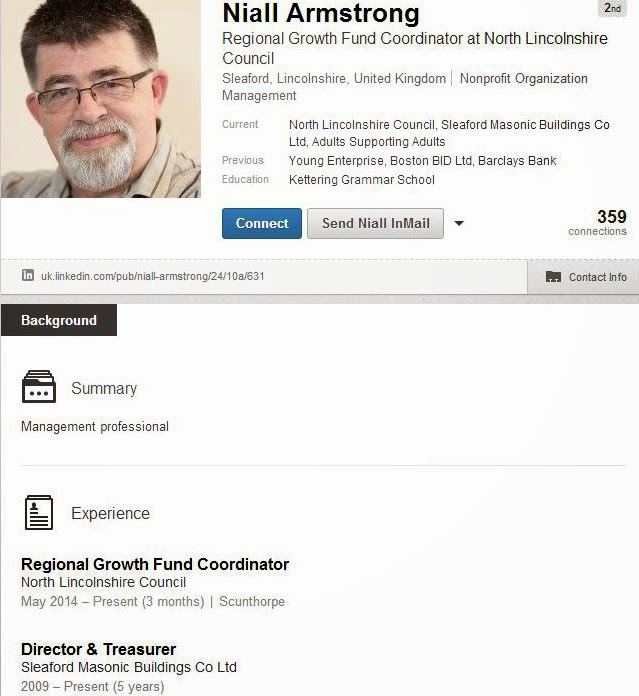
We mentioned Boston Business “Improvement” District earlier on, and one-time levy payers to that organisation will certainly be pleased to learn that the company’s former manager Niall Armstrong, who was roundly humiliated when Boston businesses decided to vote the BID out of existence, has landed on his feet at last.
He has popped up on LinkedIn with a new look to match his new job.

click on photo to enlarge it
For the past couple of months, Mr Armstrong has been Regional Growth Fund Co-ordinator for North Lincolnshire – which marks a move from a publicly funded organisation to a government funded quango-style operation … although he has held a long running role as director and treasurer of Sleaford Masonic Buildings since 2009.
Clearly, his time since leaving Boston BID has been well spent, as among his talents, he now lists business strategy and planning, management, event management, strategy and leadership.
And before you ask … yes, it is the same Niall Armstrong.

***

Whilst we are sure that the use is an important one, we wish that some alternative could have been found for the former Haven Art Gallery in Boston’s “Cultural Quarter” as it is laughingly described,  than to turn it into a training centre for 16-19 year olds who are  not in education, employment or training – NEETs.
The £1 million pound gallery – another of Boston Borough Council’s great white elephants – opened in 2005 and was mothballed five years later as a cost-cutting exercise.
For years it has been on the market to rent, with a tenant sought for a five to ten year period at £38,000 a year.
Now, Nacro –  formerly the National Association for the Care and Resettlement of Offenders, and now styled the crime reduction charity –  will offer a programme of courses, including sport, child care, retail, English, maths and ICT qualifications, “employability” plus traineeships and work placements.
If the names of these courses sound familiar, it’s because most of them are already on offer at Boston College, and around half a dozen other training centres that litter the town centre.
The Haven failed as a gallery because it never had anything worth looking at on offer –  and like many other costly ventures involving local taxpayers’ money was another example of how  the eyes of Boston Borough Council are bigger than its mouth.
We hope that Boston Borough Council will put the income from the rent to good use – perhaps some more hanging baskets to try to coax a badge out of next year’s Britain in Bloom competition judges – but we would be interested to know whether it achieved anything like the £38,000 rental that was being sought. Somehow we doubt it.
So, Boston is now the go-to centre for ‘phone shops, charity shops and training organisations.
How about a few shop shops for a change?

***

And talking of Britain in Bloom, we note the chortling from Boston Borough Council after last Friday’s visit from the judges – who were herded along a carefully chosen and adorned route guaranteed to get them into medal-minting mood.
According to the council’s Daily Drone, “All the indications are good – judge Ian Cooke, from the Royal Horticultural Society, said “Wow” after touring the town and “Wow” again when he and fellow RHS judge Diane Moore concluded with a visit to Boston West Academy.”
Wow!
That could, or course, mean that they were simply lost for words – or just that they might have simply been intimidated by the  numbers of hangers-on who dogged their visit  … in one photo the two judges are swamped by no fewer than 23 and in another by fifteen!
However, confidence remains high after the Drone reports “Asked for a clue as to the final result” one of the judges said: “You won’t be disappointed” – which seems a rather unfair position in which to put a so-called independent judge.
***

As the judges toured the pristine, cared for route, the rest of us had to make do with Boston in the raw.
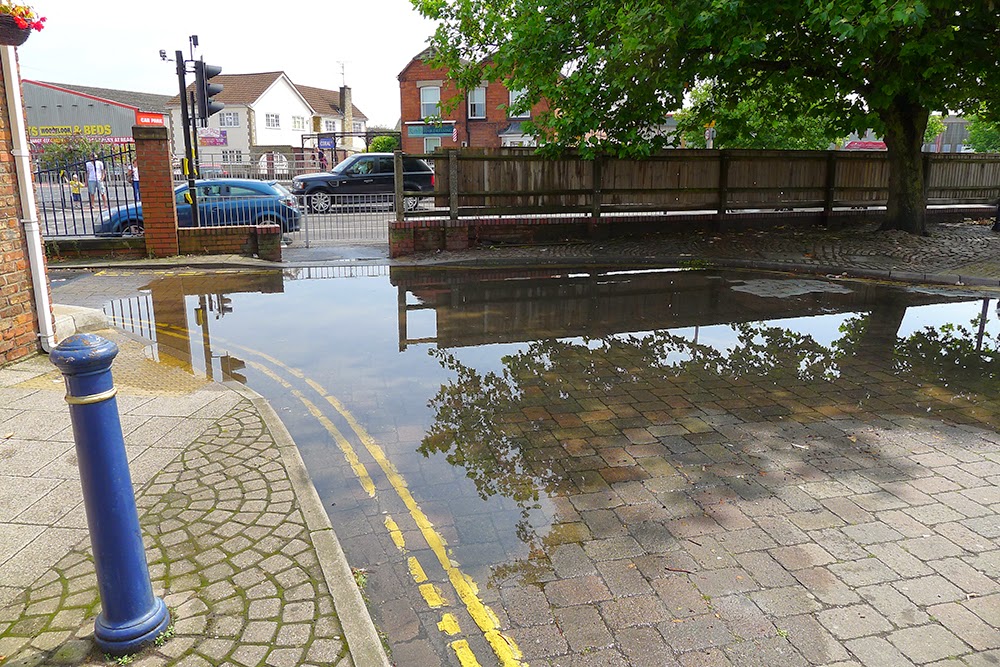
Users of the borough council’s Botolph Street car park had to negotiate water some inches deep, as did pedestrians.


It’s a problem that we have highlighted time and again, but as there are no medals involved, and it’s only the riff raff who live here who are inconvenienced, we imagine  that the problem will come and go with the rains for years to come.
***

It sounds as though our local MP Mark Simmonds can combine business with pleasure in that arduous job that takes him to almost everywhere in the world aside from regular stays in Boston.
The MP enjoyed a brief flash of fame – or rather notoriety – after the Westminster expenses debacle when it emerged that he was charging for the wine lovers’ magazine Decanter.
Now he is back in the news in a oenophilic context as the man tasked with issuing a written statement to parliament about the annual health of the government wine cellar – which is run by the Foreign Office and lies beneath a grand London mansion owned by the Queen and leased to the government – and which has stocks valued at £824,406.
We’ll drink to that!
It’s a dirty job, but someone has to do it.

***

Last week’s item about the problems at the Assembly Rooms and the rumours about the company Activ Leisure became slightly more understandable when we realised just how many companies the owner Matt Clark and his family have to keep an eye on.
The Assembly Rooms was connected with the name of a company called Totally Ordinary Limited with an address at a Lincoln postcode used by no fewer than 324 companies.
According to internet sources the company has £31,634 in cash, with assets of £59,576, liabilities of £281,458 and net worth of £-590.
But Mr Clark is also connected with so many other companies – or has been – that keeping track can’t be easy.

click on photo to enlarge it

Then there are family connections with other companies such as the subtly named Honeybars Leisure as well.
Isn’t it complicated being an entrepreneur?

***

Another burst of schadenfreude came our way with the news that the £100m bypass to ease congestion in Lincoln has been rejected by the transport secretary because of a lack of pedestrian access.
Plans for the scheme, to link Wragby Road, north of Lincoln, with the A15 Sleaford Road to the south, will have to be revised and resubmitted.
Councillor Richard (Bob the Builder) Davies, Lincolnshire’s Unilateralist cabinet member for highways, said he was "completely gutted" with the decision.
Work on the road was expected to start later this year but the plans were rejected following a planning inquiry.
The Department of Transport said: "Lincolnshire County Council's plans for a bypass did not make adequate provision for pedestrians and cyclists wishing to access Hawthorn Road, via a footbridge.
"The council is welcome to consider these conclusions and submit a fresh application."
The road was to be funded by the government with contributions from the county council and developers.
Hopefully, the delay will give Lincoln motorists a feel for the problems we face here in Boston – but without any hope of a bypass or distributor road in sight – although we doubt that it will generate any sympathy for us.
  
***

Finally, given that the essence of the written word ought to be that it is as widely understood as possible, we weren’t quite sure what this headline in the Boston Daily Burble was trying to tell us.


“Don’t let £75 fine be enough to make you spit.”
Is it an exhortation to carry on spitting despite the penalties?
It could well be.
It certainly requires careful reading.
Given that messages posted around the town to discourage spitting, urination in the street and worse are sometimes produced in foreign languages (it is not politically correct, and probably deemed racist to suggest that any particular nationality could be culpable) could we suggest that when they are produced in English they can at least be taken on board with as little ambiguity as possible.
  
You can write to us at boston.eye@googlemail.com Your e-mails will be treated in confidence and published anonymously if requested.
Our former blog is archived at: http://bostoneyelincolnshire.blogspot.com